|
|
Roseau The future of a historic town
By Elise Johnston Agar
Reprinted from Dominica Arts and Culture Expose'
June 06, 2015 5:32 P.M
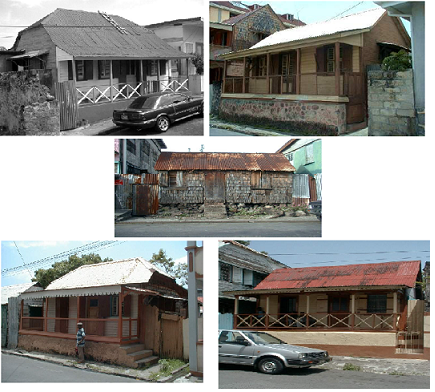
A few architectural styles seen around Roseau. |
Roseau, Dominica (TDN) How can we retain the best of a historic town while letting it grow in today's world? It is a question that most cities have struggled with. Many inhabitants of an old city, including and perhaps especially those who have since moved away, are nostalgic for “the good ole days” and may lean towards the side of preservation.
On the other hand, many users of the same city know of areas to be improved and may lean towards redevelopment.
Roseau is a great example of this dichotomy. Stretching out of the centuries-old market square, the French quarter is full of quaint hardwood and volcanic cut-stone buildings that housed merchants' shops on the ground floor and residences on the upper floor.
These were so well constructed that many survived two centuries of storms and pests, and are still used in private and commercial capacities. It is in fact, inhabitation that keeps these buildings alive with only a little maintenance, whereas the neglected buildings are of course the ones that eventually fall.
Unfortunately, the fate of numerous properties are stuck in limbo; the title still in the name of a grandfather and countless descendants with differing ideas about who the current owner is, and what should be done with it.
But, back to the question at hand of how to balance preservation with current development. It seems reasonable to attempt a little of both, in appropriate locations and manners. One strong argument is to maintain the 'aesthetic' rather than the 'authentic' in many cases.
Surely only significant properties, a residence of a famous figure or a place of an important event, need be fully preserved, as it was, exactly, at a specific time in history. The other extreme is using completely new materials and forms such as a shiny contemporary steel and glass high-rise which simply does not make sense for a number of reasons in old city centres.
Somewhere in the middle then, we can look to the 'vernacular' for architectural elements that reflect the character of a place. Interestingly enough, traditional styles developed over time by adapting to the local climate and using local materials.
This means that they are inherently more sustainable and suitable than a funky modern design that will incur huge utility costs! Examples of useful stylistic elements in the Caribbean include: jalousie windows that allow necessary airflow while providing shade from the hot sun; dormer windows that increase headroom, light and airflow in top floors; naturally insulating stone walls keep interiors cool, and verandahs that offer protection to both people and structure from rain and sun.
Recently, this architectural language has been created out of modern materials such as pvc, aluminum, wood composites and various concrete treatments. Benefits of this shift can include a reduction on the dependence on timber and longevity with minimal maintenance. A downside to these materials is that they do tend to carry a heavy environmental burden in manufacturing and transportation.
In the case of Roseau, a few key individuals were at the right place and the right time, and a committee devoted to Architectural Heritage preservation was created in The Physical Planning Division, the Advisory Committee for Architectural Heritage Preservation(ACAHP), and a local non-profit organisation Society for Heritage, Architectural Preservation and Enhancement(SHAPE) which received some institutional strengthening funding from the EU.
Between these two groups, over a decade ago, an area of Roseau was designated as an 'Environmental Protection Area'. All buildings within this zone were classified according to a detailed score card and property owners were notified as to the level of preservation, renovation or new construction recommended or allowed.
Now, as too many programmes do in Dominica, this has since fallen slightly to the side, unsupported by higher authorities and bogged down by limited resources and red tape. When a project in the district goes through the required Permission for Planning Approval procedure, it is vetted by the Technical committee and generally given the appropriate guidelines to follow. The guidelines, however good, are not legislated and therefore don't have the strength they should.
While the awareness efforts of SHAPE have not gone unnoticed, one could credit some of the preservation to simple economics. It is certainly less expensive to maintain what you have rather than tear down, dig for deeper foundations and rise up three storeys of steel, concrete and glass! The banks are now holding enough unrented properties to warrant very few significant construction loans.
Currently, there are mixed feelings about how forcefully the Planning Department should regulate the old district of Roseau and whether Dominicans should care about pleasing tourists or appealing to nostalgia. Hopefully, sustainability of materials, economics and efficiency of design will prevail, and I suspect growth will have roots in the traditional approach to development by default.
Elise Johnston-Agar grew up in Montreal, Canada and is a Carleton University architecture graduate. She met her Dominican husband Morris Agar at Carlton, and they have been practicing together in Dominica for the past 10-15 years. Elise served as a Programme Officer for SHAPE, and on the Committee for planning and formulating guidelines.

|
|
|


 | Main Page
|Radio LIVE
|Cricket TV
|DA History
|Archives
|Dominica
|Photos
|Books
|Directory
| Main Page
|Radio LIVE
|Cricket TV
|DA History
|Archives
|Dominica
|Photos
|Books
|Directory