Volume No. 2 Issue No. 30 - Monday February 25, 2008
The history and pictures of Dominica's volcanoes - Morne Trois Pitons
 By Thomson Fontaine
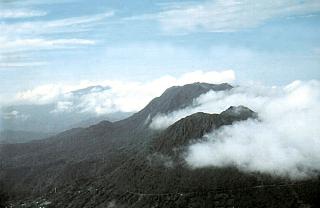
Morne Trois Pitons at 4 550 feet is Dominica's second highest mountain peak.
|
Morne Trois Pitons towers over 4 550 feet (1387 meters), making it Dominica�s second tallest mountain after Morne Diablotins.
Trois Pitons (mountain of three peaks) is located in the central part of Dominica, relatively close to the village of CastleBruce.
The large lava dome complex of Morne Micotrin (Morne Macaque) is included as part of the larger 1387-m-high Morne Trois Pitons, which lies to its immediate north.
Some of Dominica�s most breath-taking sites lies between the two domes. In fact, the Morne trios Pitons national park as it is referred to includes the boiling lake, Titouu Gorge, Boeri lake, Emearls pool, Middleham Falls and Traflagar Falls.
The domes are located along the margin of a large semi-circular depression on the western coast of central Dominica, whose origin has been variously attributed to caldera collapse, gravity sliding, or the juxtaposition of several independent volcanic centers.
Morne Trois Pitons is believed to have last erupted in 1160, the only known eruption in the last 10 000 years. However, it is believed that a thick sequence of pyroclastic flows erupted between about 40,000 and 25,000 years ago. Explosive eruptions at the Trois Piton-Microtin complex producing pyroclastic flows continued into the late Pleistocene and Holocene.
Scientist continue to caution that Dominica is one of the most volcanically hazardous countries in the world, and that a powerful eruption is expected anytime in the near future.
 Nine of the Caribbean�s sixteen active volcanoes are located on the island of Dominica. By contrast there is one each on Guadeloupe, Martinique, St. Lucia, St. Vincent, Montserrat, Saba, St. Eustacius, St. Kitts, and Nevis. There are two in Grenada.
Dominica�s nine active volcanoes are ; Morne au Diable, Morne Trois Pitons, Morne Diablotins, Morne Watts, Morne Anglais, Wotten Waven Caldera, Valley of Desolation, Grande Soufriere Hills and Morne Plat Pays.
The youngest dated volcanic deposits on the island are associated with the Morne Patates dome on the flanks of the large active Plat Pays Volcano that comprises the southwestern end of the island. This was a Pelean eruption (similar to the eruptions of Mt. Pelee on Martinique in 1902 and 1929) and radiocarbon ages from the block and ash deposits suggest it occurred about 500 year ago.
In addition there have been two steam explosions (phreatic activity) in the Valley of Desolation in 1880 and 1997. Frequent seismic swarms and vigorous and widespread geothermal activity today characterize the island. In fact it is the most worrying of all the Caribbean volcanic areas and there is a general feeling that it (like Montserrat pre-1995) is long overdue for an eruption. Scientists are predicting that there will be at least one major eruption within the next 100 years.
What is of particular concern is that the capital Roseau and most of the islands infrastructure lie on a pyroclastic flow fan derived from the Wotten Waven caldera situated on the eastern outskirts of the capital.
The pyroclastic deposits of the Roseau area abound with ignimbrites (pumiceous pyroclastic flows), surge and airfall deposits with radiocaron ages ranging from 38,000 to 1000 years B.P.
Volcanologist Haraldur Sigurdsson as long ago as 1972 described one of the units which he called the Roseau ash and together with other workers traced its submarine extension. As a result of this work they concluded that about 38,000 years ago the island erupted around 56 cubic kilometers of pumiceous materials in what was described as the largest eruption in past 200,000 years in the Caribbean.
Pyroclastic flows deposited about 30 cubic km on the Caribbean floor and the remainder was deposited on the Atlantic floor from AntiTrade Wind dispersal. More recent work suggests that there are several ignimbrite sheets separated by ancient soils and the deposits may have resulted from several eruptions. However all conclusions indicate that the capital Roseau is situated in one of the most hazardous areas of the island.
The Dominican.net will continue to bring you the history and photos of this aspect of our beautiful island over the next several issues.  E-mail to a friend
Related Articles
The History of a Volcanic Island
Dominica's volcanos
Morne Trois Pitons
The Morne Plat Pays (Flat Footed) Volcano
The Morne Watt (Rat Mountain) Volcano
The Morne Diablotins (little devils) Volcano
Dominica Eco Trip
Dominica Treasure Island
The following references are the sources used in writing the articles on Dominica�s volcanos: (i) Bellon H, 1988. Reconnaissance chronologique des deux premieres phases d'activite volcanique en Dominique (Petites Antilles). Compte Rendus Acad Sci Paris, 306: 1487-1492;
(ii)Lindsay J M, Smith A L, Roobol M J, Stasiuk M V, 2005b. Dominica. In: Lindsay J M, Robertson R E A, Shepherd J B, Ali S (eds). Volcanic Hazard Atlas of the Lesser Antilles, Trinidad and Tobago, Seismic Res Unit, Univ West Indies, p 1-47;
(iii) Robson G R, Tomblin J, 1966. West Indies. Catalog of Active Volcanoes of the World and Solfatara Fields, Rome: IAVCEI, 20: 1-56;(iv)Shepherd J B, 1989. Eruptions, eruption precursors and related phenomena in the Lesser Antilles. In: Latter J H (ed), Volcanic Hazards - Assessment and Monitoring, Berlin: Springer-Verlag, p 292-311;
(iv) Shepherd J B, 2001. Volcanoes of the eastern Caribbean: past activity and future hazards. Paper presented at the Workshop on Volcanic and Seismic Hazards in the eastern Caribbean, May 28- June 1, 2001, 57 p; and
(v) The Smithsonian Institute Website http://volcano.si.edu.
|
|