Volume No. 1 Issue No. 100 - Monday May 7, 2007
World Bank Calls for Investment in Crime Fight in the Caribbean

 Labelling crime as a development issue a major report released by the World Bank is urging the international community to increase funding to tackle the high crime rates in the Caribbean - some of which are the highest in the world. Labelling crime as a development issue a major report released by the World Bank is urging the international community to increase funding to tackle the high crime rates in the Caribbean - some of which are the highest in the world.
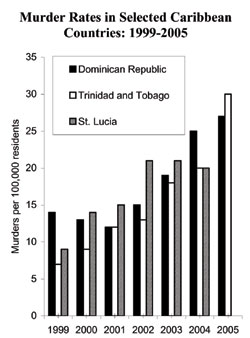
The report Crime, Violence, and Development: Trends, Costs, and Policy Options in the Caribbean released by the World Bank and the United Nations Office on Drugs and Crime (UNODC) yesterday said that crime and violence were impacting business and were a major obstacle to investment, undermining growth, threatening human welfare, and impeding social development.
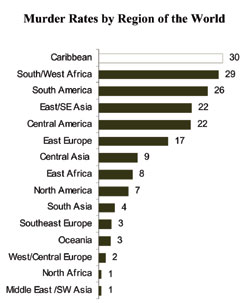 "The report clearly shows that crime and violence are development issues. Donors and OECD countries need to work together with Caribbean countries to reduce the current levels in the region," said Caroline Anstey, World Bank Director for the Caribbean. "Some of the factors that make the Caribbean most vulnerable to crime and violence, mainly the drug trade and trafficking of weapons, require a response that transcends national and even regional boundaries."
It has made a series of recommendations to reverse this trend including not over-relying on the justice system but implementing preventative measures, creating plans to re-integrate criminal deportees into the system point to the measures taken by the Office for the Resettlement of Deportees in St. Kitts and Nevis as an example, and better gun control.
"Although there is no one 'ideal' approach for crime and violence prevention, interventions such as slum-upgrading projects, youth development initiatives and criminal justice system reform can contribute to reducing crime and violence," said Francis Maertens, UNODC Director, Division for Policy Analysis and Public Affairs.
 Key messages and recommendations from the report include:
1. Caribbean countries are transit points and not producers of cocaine. Interdiction needs to be complemented by other strategies outside the region: principally demand reduction in consumer countries and eradication and/or alternative development in producer countries.
2. Gun ownership is an outgrowth of the drug trade and, in some countries, of politics and associated garrison communities. Although reducing gun ownership is difficult, better gun registries, marking and tracking can help, as can improved gun interdiction in ports. Policies should also focus on limiting the availability of firearms and on providing meaningful alternatives to youth.
3. Deaths and injuries from youth violence constitute a major threat to public health and social and economic progress across the Caribbean. Youth are disproportionately represented in the ranks of both victims and perpetrators of crime and violence.
4. Although the average Caribbean deportee is not involved in criminal activity, a minority may be causing serious problems, both by direct involvement in crime and by providing a perverse role model for youth. The report recommends that more services be offered to reintegrate deportees, with deporting countries contributing to the cost of these programs.
5. In general, there is an over-reliance on the criminal justice system to reduce crime in the region. At the same time, it must be recognized that some types of crime such as organized crime, drug and firearms trafficking are generally impervious to prevention initiatives; their control requires an efficient criminal justice system. Urgent priorities for improving the criminal justice system in the region include: the development of management information systems, tracking of justice system performance; monitoring of reform programs and increased accountability to citizens.
6. Several countries are increasingly investing in crime prevention - using approaches such as integrated citizen security programs, crime prevention through environmental design, and a public health approach that focuses on risk factors for violent behaviors. These alternative approaches have significant potential to generate decreases in both property crime and inter-personal violence.
7. Youth violence is a particularly serious problem in the region, and youth homicide rates in several countries of the region are significantly above the world average. To address issues of youth violence, Caribbean policymakers should invest in programs that have been shown to be successful in careful evaluations such as: i) early childhood development and mentoring programs; ii) interventions to keep high risk youth in secondary schools; and iii) opening schools after hours and on week-ends to offer additional activities and training.
8. Many of the issues facing the Caribbean transcend national boundaries and require a coordinated regional and international response. Demand for drugs emanates from Europe and the United States; deportees are sent back to the region from the United States, the United Kingdom, and Canada; and many weapons that are trafficked are brought from the United States.
9. Crime and violence are not immutable. While the Caribbean faces serious challenges, especially in the areas of drugs, guns, and youth violence, informed policies at the national, regional and international levels can make a significant difference.
|
|