Volume No. 2 Issue No. 12 - Monday September 10, 2007
Sir John: Master politician and nation builder
 Caribbean360.com Caribbean360.com
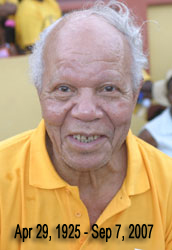
Sir John Compton died on Thursday
|
CASTRIES, St Lucia, September 8, 2007 - Sir John George Melvin Compton, who died last evening at Tapion Hospital here at age 82, became involved in politics at an early age and fought strenuously for the rights of the working classes and the impoverished as well as for unity of sister Caribbean islands.
Sir John Compton, who was knighted by Queen Elizabeth II in 1997, was born on April 29, 1925 on the small Grenadine island of Canouan in St Vincent and the Grenadines.
He spent his childhood there and attended Government School on the island before moving to St Lucia for his secondary schooling after which he studied law in England at Gray's Inn and London School of Economics.
He was called to the bar August 7, 1951 and three years later entered politics as an independent candidate in the elections and won the Micoud/Dennery seat on October 18, 1954.
He was appointed a member of the then executive committee with responsibility for social affairs in 1955.
He had a passion and fought for the working classes and impoverished people and it came as no surprise that the following year he joined the St Lucia Labour Party (SLP) which sought to represent the under-privileged classes.
Five years later, in 1961, he fell out with the SLP and formed his own National Labour Movement (NLM) but within three years, Compton's sights were set higher as he merged his party with the People's Progressive Party to form the United Workers Party (UWP) which has evolved as, and remains to this day, one of the two major political parties in St Lucia.
It was in 1964, the year of the birth of the UWP that the party won elections. Sir John was appointed as the chief minister, succeeding the first chief minister George Charles of the SLP, after whom the airport in the capital city, Castries, is named.
He was appointed the first premier in 1967 with the island's move towards statehood. He led the country towards full independence from Britain on February 22, 1979 and was appointed the first prime minister.
However, his party was defeated at the polls five months later on July 2, 1979.
Master politician
The SLP's reign did not last long. In the next three years the country went through three prime ministers, one of which, Winston Cenac, died in office.
Sir John and his UWP were successful at the polls on May 3, 1982 and he started his second term of office as prime minister which he handed over on April 2, 1996 at age 70, to Dr Vaughn Lewis, a former lecturer at the University of the West Indies and former director of the Organisation of Eastern Caribbean States.
Sir John hand-picked Dr Lewis to succeed him as prime minister but the economist proved to be significantly more successful at finance than he was at politics.
Compton's UWP suffered the most embarrassing and crushing defeat ever at the polls on May 24, 1997 under Dr Lewis' leadership.
Modernisation of St Lucia
The aging Compton, engineered his prot�g�'s downfall at a subsequent party conference, got himself re-elected to the leadership and as an octogenarian and veteran politician, he masterminded a campaign that Dr Kenny Anthony and his SLP could not fend off, making a dramatic entry back into politics and installing his UWP where he thinks it ought to be - at the pinnacle of political power.
Sir John has been hailed as the Father of Independence but more than that, he is credited with modernising his adopted homeland with major reconstruction of its social and economic base. He phased out sugarcane and brought in bananas at precisely the right time earning significant foreign exchange to support the modernisation of the country into one of the major developing economies in the Caribbean today.
His support for Caribbean unity was unwavering and he was one of those whose work led to the formation of CARICOM.
He also played a role in the establishment of the Caribbean Development Bank, the West Indies Association States Council of Ministers, the Eastern Caribbean Common Market, and the Organisation of Eastern Caribbean States.
|
|