|
 |

Volume No. 1 Issue No. 89 - Saturday November 11, 2006 |
Hurricane Katrina Evacuees in Washington DC
 Dr Emanuel Finn Dr Emanuel Finn
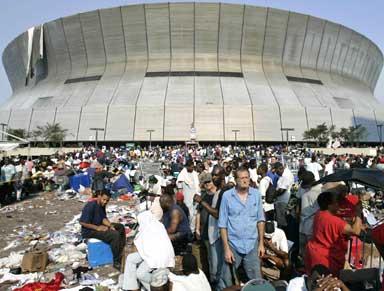
On September 5th, 2005 nearly 300 evacuees who were airlifted from Louisiana arrived at the DC National Guard Armory, which had been turned into a welcoming and comfortable shelter for victims of Hurricane Katrina.
In just days, the population at the Armory dropped to less than 150, after dozens of individuals and families found other living arrangements with relatives and friends.
Immediately after the buses with the evacuees rolled through the gates of the Armory under police escort, people stepped out of the buses exhausted, homesick and shell-shocked.
Some were clutching pillows with faces bandaged and others were limping from injuries suffered during the hurricane. It was a very emotional moment for those who were present to witness.
A day before the buses arrived, the District of Columbia Department of Health Oral Health Division went to into high gear at the Command Center located at the old DC General Hospital.
 My staff and I along with a group of oral health providers including dental residents and students at Howard University College of Dentistry, Colgate's Bright Smiles/Futures mobile dental van, and dental residents at St. Elizabeth's' Hospital, worked all night preparing our clinics onsite for treating the evacuees.
Initial care was provided to the patients in greatest need and those that were injured during the hurricane. I was responsible for coordinating follow up dental care for those who remained in the DC metropolitan area.
Two hundred evacuees were immediately enrolled in the DC Medicaid program and one hundred in the Health Care Safety net program (health insurance for low income individuals and families).
Emergency legislation was passed in the District of Columbia to enable the evacuees' access to healthcare, counseling and other services with minimal interruption or delay.
The Relocation and Recovery Assistant Emergency Act legislation of 2005 authorized the Mayor of DC, upon declaration of a state of emergency or disaster to provide disaster services, relocation and recovery assistance to evacuees or victims of a disaster.
The legislation is meant to ensure that there would be little or no effect on current services for District-based homeless or low-income individuals and families.
The Act permits the District to waive documentation requirements such as social security cards, which may have been lost or destroyed, and seek third party verification.
The last of the evacuees from Louisiana moved out of the DC Armory on October 4th, 2005. This brought an end to a rescue and shelter effort that helped hundreds of victims get back on their feet.
The closure of the shelter marked a hallmark for the District of Columbia. The city mobilized dozens of agencies and thousands of Washington-area residents and volunteers in an unprecedented effort to offer assistance to the region devastated by Hurricane Katrina.
The hurricane that slammed into the Gulf coast of the United States was massive and required an equal response. It was the sixth largest and deadliest hurricane ever recorded in the Atlantic basin.
One thousand, three hundred and two (1,302) lives were lost. Total damage by the monster storm is estimated to have cost between 170 and 300 billion U.S. dollars.
During the entire experience at the Armory, I could not help but think of my island home of Dominica and the devastation that will occur if a hurricane hits of the magnitute of Katrina.
Given the changing and unpredictable weather patterns with global warming, there is a very strong possibility that the nature isle, which sits in a hurricane alley will be visited by an unfriendly storm in the near future.
According to the National Hurricane Center in Miami, since 2005 all the scientific evidence that is currently available points to the fact that the region will experience more frequent and intense storms for the next fifteen to twenty years.
Much more than the average eleven hurricanes that was expected within a hurricane season in past decades.
During these past years before global warming and green house gas effects and the weather phenomenon known as El Nino/El Ni�a, (unusual warming and cooling of oceanic surface temperatures) storms were unheard of and had almost negligible negative impact on adverse weather patterns and conditions.
I remember back in La Plaine School in the late 60s and early 70s in Ms. Bruney and Mr. Vigilant�s classes, we would recite a poem about the predictable hurricane season. This poem heightened our awareness of the season.
Also because our community is located on the windward coast (Au Vent), we historically endured more storms than the rest of the island. The poem went this way: July it starts, Come August you must; September remembers and October it�s all over.
Today the hurricane season comes earlier and lasts longer with greater unpredictability. They arrive with more devastating winds that top more than 200 miles per hour with storm surges capable of submerging coastal lowlands within minutes.
Today these weather patterns are so detrimental to the world that urgent political and scientific efforts are being mobilized in finding solutions to curb global warming.
Recently the majority of world countries signed up to the Kyoto Protocols which would reduce global warming due to greenhouse gases.
But the impact of climate change is being felt most harshly on the world�s poorest communities, countries and small island nations.
Unpredictable weather patterns interfere with sustainable development and equity among economically challenged states and communites. These patterns result in storms, volcanoes, earthquakes and tsunamis.
So the question is; when the next angry hurricane makes landfall in Dominica will the island have all the 'right stuff' to deal with the disaster?
Will local and regional trained personnel be in place to mitigate the suffering and loss of life and property? How quickly will the Caribbean Disaster Response Agency (CDERA) arrive on the ground with medical supplies and humanitarian aid?
Will there be U.S, French, Dutch or British Naval vessels in nearby waters to assist with relief, rescue and recovery operations?
How well will Dominica�s office of emergency preparedness handle the disaster? These questions kept on playing over and over in my mind.
On day two of the operations, as I arrived very early at the check point at the Armory�s main gate, I was greeted by an armed and sharply dressed sergeant of the DC Army National Guard.
A few seconds elapsed before I realized that it was my nephew, who a year before completed a tour of duty in Iraq in support of the war efforts.
I jumped out of the DC Department of Health marked car which I was driving and embraced him. It was a very gratifying and proud moment for us. We were now involved in something that was much bigger than us.
My Nephew and I talked about the strong winds, rains and death left by hurricane David in 1979 in La Plaine and the rest of the island.
Before we parted, we talked about the increased devastation and destruction that would result if a vicious and angry hurricane like Katrina slams the island. Something was very wrong with the �picture� of displaced Americans far away from their homes and displaced families.
I also (jokingly) told him that the �picture� is also upside down because we are supposed to be the (self-exiled) refugees in America from a small beautiful but challenged island probably needing assistance, not the other way around.
We then parted and headed to the business and humbling task at hand. Being involved in a wave of humanity taking care and comforting Americans from the south that were displaced by the mighty and unpredictable forces of nature.
In the midst of the Creole festival activities and Independence Day celebrations and festivities, I can�t help but remember that it is also the hurricane season.
I can�t see it any other way because the season is a time when mother nature has (and is planning) to unleashed its most ferocious and deadly natural forces on mankind and the environment.
Dr. Finn is the Dental Director of the District of Columba (Washington DC) Department of Health.
|
|

|